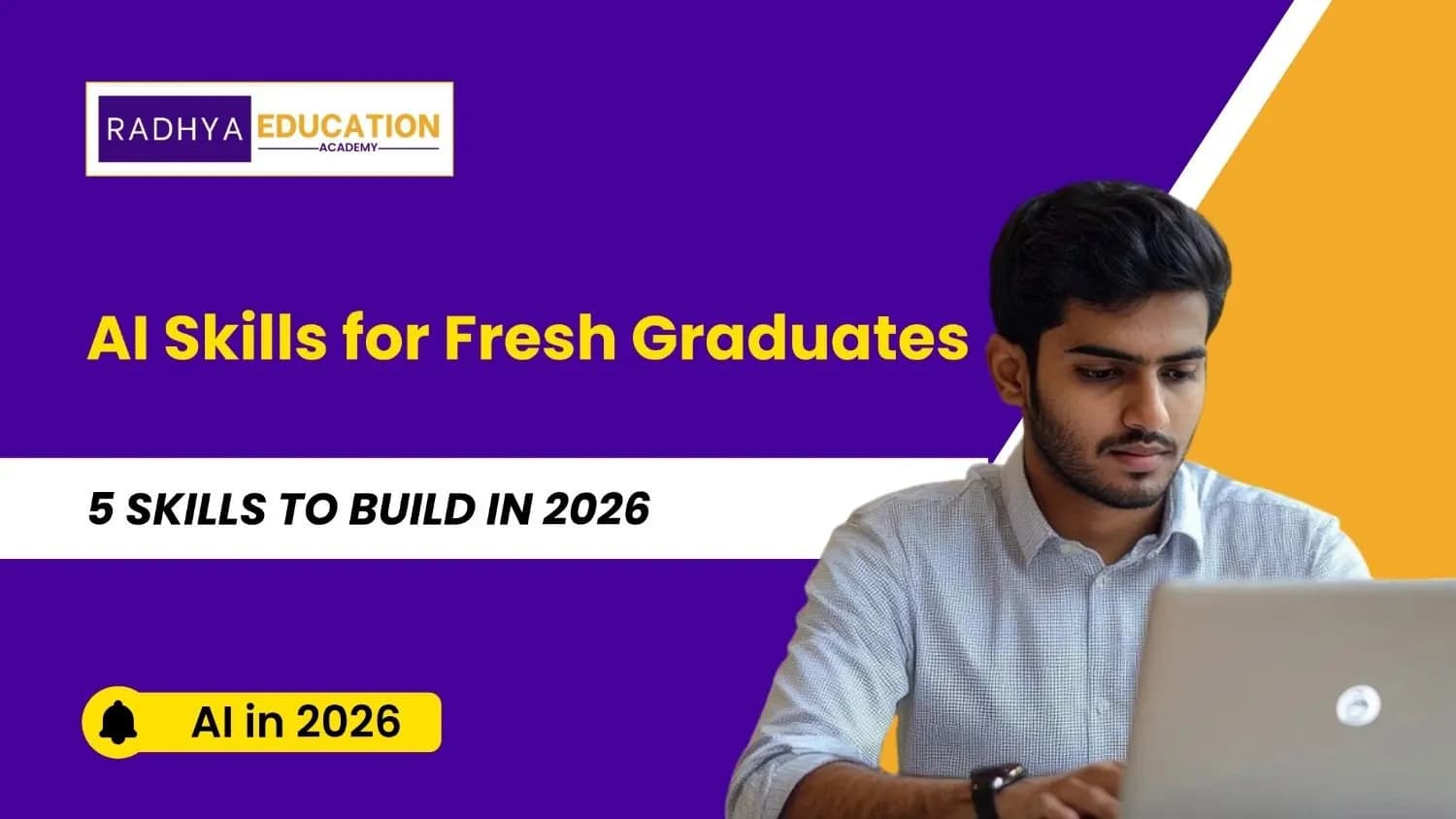
AI Skills for Fresh Graduates 2026: 5 Skills to Build
What Skills Should Fresh Graduates Build in the AI Era? A 2026 Guide Beyond Degrees
For years, the advice given to fresh graduates was fairly predictable: earn a good degree, learn a few technical skills, prepare for interviews and start applying.
That formula is getting harder to rely on as India's overall graduate employability rate has climbed to 56.35% in 2026, compared with 46.2% four years earlier. At the same time, the India Skills Report 2026 shows that employability is not moving in the same direction across every qualification. MBA graduate employability, for example, declined from 78% to 72.76%, while computer science and IT graduates remained at relatively high levels.
So, what is happening?
The problem is not that degrees have suddenly become useless. A degree still gives a graduate subject knowledge, credibility and a starting point for a career. The bigger change is what employers expect on top of that degree.
A graduate who knows their subject, can work with AI tools, understands data, communicates clearly and can show evidence of actually applying those skills is entering the job market differently from someone whose strongest credential is simply a degree certificate and that distinction matters in 2026.
Not Sure Which Skills You Should Build for Your Career?
Your next step does not have to mean collecting another random certificate.
Radhya Education Academy's career counsellors can help you understand which skills, certifications or higher-study options actually make sense for your degree, career interests and current level of experience.
The Fresh Graduate Job Market Is Changing - But Not in the Way Many Think
The fresh graduate job market is changing, but AI is not simply replacing entry-level jobs. Instead, employers are increasingly looking for graduates who can combine their academic knowledge with practical digital and AI skills.
Routine tasks are becoming more automated, while skills such as problem-solving, communication, critical thinking, adaptability, and AI literacy are becoming more valuable. This means a degree alone may no longer be enough to stand out.
The World Economic Forum's Future of Jobs Report 2025 projects a net gain of 78 million jobs globally by 2030, even after an estimated 92 million existing roles are displaced. It also estimates that around 39% of workers' core skills could change or become outdated by 2030.
Fresh graduates who learn how to use AI effectively, understand their field, and demonstrate practical skills through projects or real-world experience can position themselves more effectively for changing workplace expectations.
Feeling left out in this era, read our guide on NMIMS Online MBA in IT and pursue your dream career with updated market trends.
5 Skills Fresh Graduates Should Build in 2026
1. Learn to Work With AI - Not Just Talk to It
Knowing how to open ChatGPT and ask a question is no longer much of a differentiator. Millions of students and professionals can do that. The more useful skill is learning how to make AI part of an actual workflow.
Instead of simply writing "ChatGPT" under technical skills on your resume, try building an actual workflow around AI. For example:
Research → AI assistance → fact-checking → analysis → human decision → final presentation
2. Become Comfortable With Data
You do not need to become a data scientist but being uncomfortable with numbers and data can increasingly become a disadvantage.
A fresh graduate should at least be able to:
- read a basic dashboard;
- understand percentages and trends;
- work comfortably with spreadsheets;
- organise a dataset;
- identify obvious patterns;
- question suspicious numbers;
- create a simple chart;
- explain what the data means in plain language.
The exact tools will depend on your career. As the point is not to turn everyone into a data analyst but to make data part of your decision-making process.
3. Develop the Skills AI Cannot Simply Hand You
Soft Skills like analytical thinking, problem-solving, creativity, communication and adaptability can sound like generic resume words but they are not.
Consider a situation where an AI tool gives you three possible solutions to a business problem. "Which one should the company actually use?" - That's where the soft skill is applied based on the requirements.
4. Build the Habit of Learning After College
One uncomfortable reality of the AI era is that today's most useful tool may not be tomorrow's. That means students should be careful about building their entire career identity around one software platform, one certification or one technology.
The World Economic Forum estimates that around 39% of core skills could change or become outdated by 2030.
The practical lesson is simple: Do not just learn a tool. Learn how to learn.
5. Combine AI With Your Actual Subject Knowledge
This may be the most important skill combination for a fresh graduate. AI knowledge without domain knowledge can be shallow. Also domain knowledge without the ability to use modern tools can become less efficient.
The stronger combination is: Domain expertise + AI + data + judgment + communication
NASSCOM's research, emphasises the combination of AI, strong fundamentals, domain expertise and sound judgment rather than generic AI-tool familiarity.
IIM calcutta is also including AI first Online MBA with regular degree in 2026.
How These Skills Differ Across Degree Backgrounds
There is no single AI-era roadmap that works equally well for every graduate. Your starting point matters.
Engineering and Computer Science Graduates
Technical graduates may already have exposure to programming, databases, cloud computing or other technology. But technical knowledge alone does not automatically translate into employability.
Projects, problem-solving, communication and the ability to work with AI-assisted development tools can make that technical foundation more relevant.
BBA and Commerce Graduates
This is an interesting area because business roles are increasingly being influenced by AI without becoming purely technical roles.
Commerce graduate employability increased to 62.81% in the India Skills Report 2026, with BFSI and fintech cited among the areas contributing to demand.
If you're considering whether management education can help you build these capabilities, you can also explore our guides on Online MBA in Artificial Intelligence and Online MBA in Data Science.
Arts, Humanities and Social Science Graduates
AI is not limited to coding departments. Graduates in English, psychology, sociology, economics, political science, communication and related fields can find AI increasingly relevant to research, content, communication, analysis and other knowledge-based work.
For these graduates, strong writing and critical thinking can become even more valuable when combined with AI literacy.
Science Graduates
Science graduates can similarly benefit from combining their subject knowledge with data literacy and AI-assisted research. For example, someone working in life sciences, environmental science or research may increasingly encounter data-heavy workflows.
Learning how to interpret datasets, understand AI-assisted analysis and communicate findings can therefore complement, rather than replace their core scientific knowledge.
If you are about to purse your post graduation degree, read our guide on Most Valuable Online MBA specialization in 2026.
What Is the Government Doing About the AI Skills Gap?
The Indian government has also been investing in AI and emerging-technology education.
Under the IndiaAI Mission, the FutureSkills pillar is designed to expand AI education and support students and researchers working in AI-related areas. The programme includes support for PhD scholars, postgraduate students and undergraduate students, along with IndiaAI Data and AI Labs in Tier 2 and Tier 3 cities.
Another programme worth knowing about is FutureSkills PRIME, run by MeitY in collaboration with NASSCOM.
What Should a Fresh Graduate Actually Do in 2026?
Knowing which skills matter is one thing, but knowing where to start is another. You do not need to learn everything at once. A more realistic approach is to build your skills step by step, starting with the fundamentals and gradually adding practical AI, digital, analytical, communication, and domain-specific skills that align with your career goals.
Step 1: Pick one AI tool relevant to your field
Do not try to master ten tools simultaneously. Choose one and learn how it can genuinely improve a task you already understand.
Step 2: Build one small project
This is where learning becomes tangible. For example:
- analyse a public dataset;
- create a simple business dashboard;
- prepare an AI-assisted market research report;
- build a financial model;
- conduct a customer survey and analyse the results;
- create a content strategy using AI and human research.
The project does not need to be huge. It needs to be real enough to demonstrate what you can do.
Step 3: Document what you learned
Put the project on your resume, portfolio or LinkedIn profile.
But don't simply write: "Completed AI project."
Explain the problem, tools you used, what you did personally, What did the analysis show and What would you improve next time? - That gives an interviewer something concrete to discuss.
Step 4: Improve your communication
Take your project and explain it in three minutes. Then explain it in one minute. Then explain it in two sentences.
If you can do that clearly, you are developing a skill that will help far beyond your first interview.
Step 5: Keep learning after graduation
Your first job should not mark the end of learning.
In an environment where technologies and job requirements continue to change, the ability to keep upgrading yourself may become one of the most valuable career assets you have.
Common Mistakes Fresh Graduates Make in the AI Era
Mistake 1: Collecting AI Certificates Without Building Anything
Mistake 2: Treating ChatGPT as a Substitute for Thinking
Mistake 3: Ignoring Your Degree Specialisation
Mistake 4: Ignoring Communication
Mistake 5: Trying to Learn Everything at Once
If you are already a graduate the best solution is to pursue an Online MBA and keep learning new market trends simultaneously.
Frequently Asked Questions
Is a technical degree necessary to build AI skills as a fresh graduate?
No. AI literacy, data skills, analytical thinking and effective communication can be useful across engineering, commerce, management, arts and science. The important part is connecting these skills with your existing subject knowledge.
How is AI changing entry-level jobs in India?
AI is increasingly being used to automate or accelerate repetitive tasks. The original article cites NASSCOM research highlighting basic coding and manual testing among areas affected by generative AI, while also pointing to growing demand for people who can combine AI tools with fundamentals, judgment and domain expertise. This does not mean that entry-level jobs simply disappear. In many cases, the nature of the work changes.
What is the difference between being AI proficient and AI native?
In the NASSCOM framework cited in the article, an AI-proficient person can use AI tools competently. An AI-native professional goes further by using AI as a regular collaborator while validating its output, applying independent judgment and combining it with domain expertise.
Where can Indian graduates find low-cost AI learning opportunities?
FutureSkills PRIME is one government-supported option for exploring courses related to AI and emerging technologies. The IndiaAI Mission's FutureSkills initiative is another programme focused on expanding AI education.
Should commerce or arts graduates be worried about AI?
AI will affect many knowledge-based roles, but that does not mean non-technical degrees are becoming irrelevant. In fact, the stronger approach may be to combine your existing subject expertise with AI and data literacy.
A commerce graduate who understands finance and can use modern analytics tools has a different profile from someone who only knows how to use an AI chatbot.
How quickly do AI skills become outdated?
Individual tools can change quickly, and the WEF estimates that around 39% of core job skills could change or become outdated by 2030. That's why graduates should focus not only on learning particular tools but also on developing transferable skills such as analytical thinking, problem-solving, communication and adaptability.
Still Unsure What You Should Learn After Graduation?
That's where personalised guidance can help.
Connect with our Free counsellors and build your 2026 career roadmap.
Conclusion: Don't Compete With AI - Learn How to Work With It
For fresh graduates, the AI era can feel confusing because every few weeks there is a new tool to learn, another job role being discussed and another prediction about how technology will change employment.
It is easy to react by trying to learn everything but that is probably not the most useful strategy. The bigger opportunity is to become the kind of professional who can use technology without depending on it blindly.
- Know your subject.
- Understand data.
- Use AI intelligently.
- Question its output.
- Solve problems.
- Communicate your ideas.
- And keep learning when the tools change.
A degree can give you the foundation. AI can help you work faster. But the combination of knowledge, judgment, adaptability and the ability to apply what you know is what can make that foundation valuable in the workplace.
In Case You Missed It
Manipal Jaipur Online MBA Admissions Open July 2026: Fees, Eligibility & Last Date
Mumbai University Distance MBA 2026: MMS Fees, Eligibility & Admission
Maharashtra College Admissions 2026: UG & PG Registration, CAP Process & Colleges
DY Patil Online MBA Admission 2026: Last Date, Fees, Eligibility & Specializations
NIMS University Jaipur Distance Education 2026: Courses, Fees & Admissions
IGNOU Online MBA Admission 2026: Complete Guide on Fees & Eligibility
Contact Us
Fill the form and our expert counsellor will connect with you shortly.
We hate annoying calls too. No spam, no sales calls
Join 10,000+ students who've transformed their careers